
Simulatore di segnale RF Northrop Grumman Compact CEESIM-VPX
Northrop Grumman Compact CEESIM-VPX RF Signal Simulator
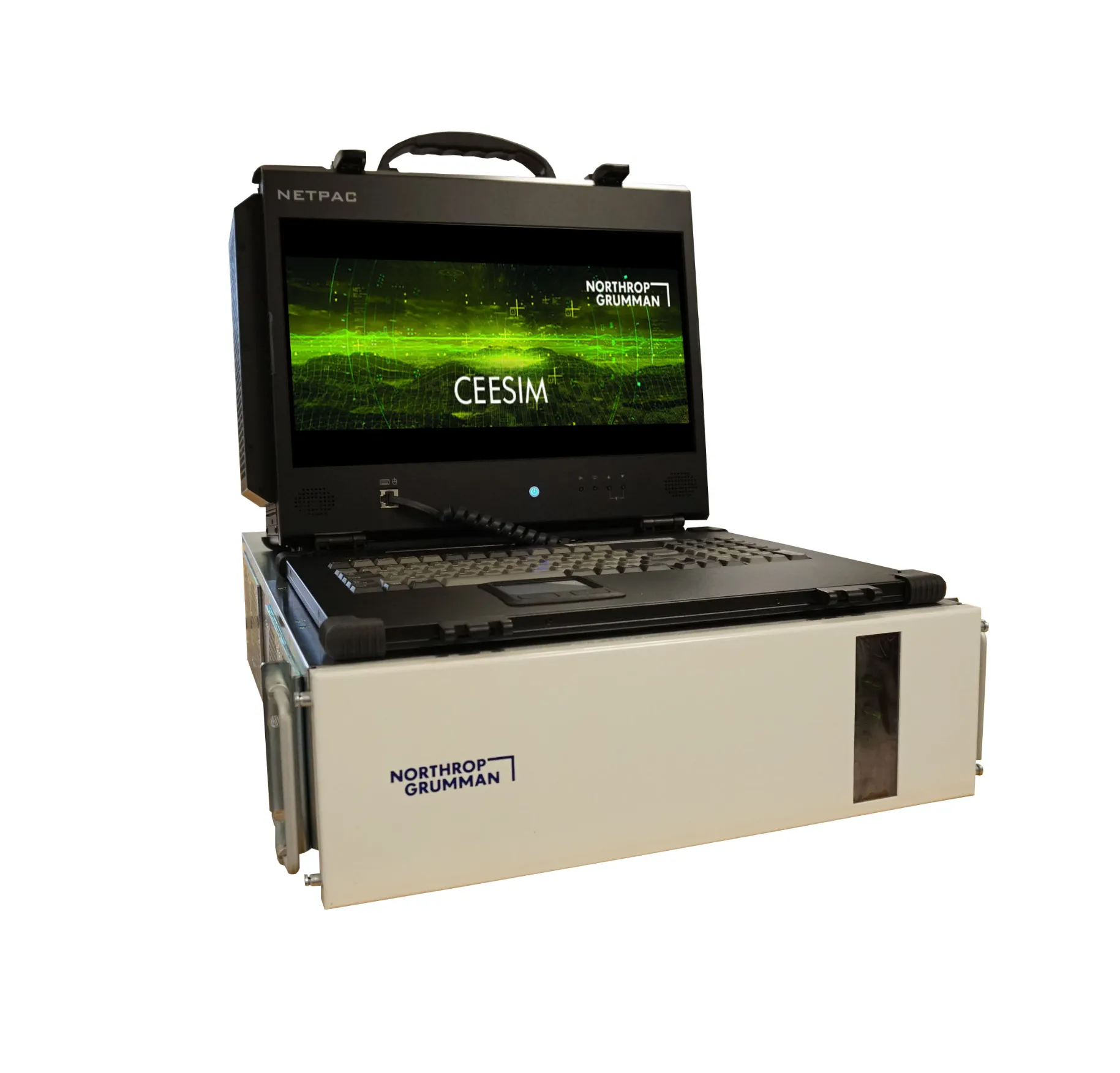
Il Northrop Grumman Compact CEESIM-VPX è un simulatore di minaccia RF/EW con copertura in frequenza da 20 MHz a 40 GHz, sintesi DDS, stimolo ad alta fedeltà e piena compatibilità con il sistema CEESIM.
Dettagli prodotto
| Modello | COMPACT CEESIM-VPX |
| Produttore | Northrop Grumman |
| Categoria | Generatori di Segnali RF e Microonde |
| Disponibilità | Su ordinazione |
Descrizione
Panoramica
Il Northrop Grumman Compact CEESIM-VPX è un simulatore di minaccia RF/EW (guerra elettronica) conveniente progettato per il test e la validazione di sofisticate apparecchiature di guerra elettronica. Basato sulla comprovata tecnologia CEESIM a grandezza naturale, la configurazione VPX compatta fornisce generazione di stimolo RF ad alta fedeltà su un'ampia gamma di frequenze con un ingombro ridotto adatto a ambienti di test da banco e mobili, incluse camere anecoiche e campi liberi.
Caratteristiche principali
- Copertura in frequenza da 20 MHz a 40 GHz con risoluzione di 1 Hz
- Controllo della frequenza con Direct Digital Synthesis (DDS) per generazione di stimolo accurata e flessibile
- Generazione RF ad alta fedeltà con modulazioni intrapulso complesse
- Tempo di sintonizzazione veloce di 0,5 microsecondi per test di scenario dinamico
- Densità di emettitore multiplo fino a 1 MPPS per canale
- Coerenza di fase su tutti gli emettitori per funzionamento multi-canale sincronizzato
- Memoria MOP (Modulation Operation Pattern) fino a 2 GB con streaming di dati esterno
- Compatibilità completa di scenario ed emettitore con sistemi CEESIM standard
- Validazione TRVAL comprovata su programmi di difesa statunitensi
- Estensioni di frequenza opzionali Ultra-Low Band (ULB) e Millimeter Wave (MMW)
Capacità tecniche
- Accuratezza di frequenza: ±2 Hz su tutte le bande
- Rumore di fase a offset di 1 MHz: -130 dBc/Hz (20 MHz–18 GHz), -125 dBc/Hz (18–40 GHz)
- Rumore in banda larga: -85 dBc/MHz tipico su 20 MHz–40 GHz
- Deviazione FM: ±500 MHz con accuratezza di ±1%
- Risoluzione della modulazione di fase: 1 grado con accuratezza di ±2 gradi
- Frequenza di campionamento MOP massima: 1280 MSPS per riproduzione di forme d'onda complesse
- Nessuna calibrazione di emettitore richiesta per distribuzione rapida
Applicazioni
- Test e validazione di sistemi di guerra elettronica (EW)
- Simulazione di minaccia radar e modellazione di emettitore per qualificazione di sistema
- Stazioni di test di sub-assemblaggio e ambienti SIL (Software-in-the-Loop)
- Test in camera anecoica e campo liberto per piattaforme EW
- Test di integrazione su sofisticati programmi di difesa statunitensi
- Prototipazione rapida e R&S per generazione di stimolo di minaccia
Configurazioni di sistema
- Canale singolo: 0,5–18 GHz con porta di uscita omnidirezionale singola
- Canale doppio: 0,5–18 GHz con porta di uscita omnidirezionale singola
- Frequenza estesa: 20 MHz–40 GHz omnidirezionale singola (richiede slice RF ULB/MMW)
- Multi-porta avanzato: 0,5–18 GHz con 4 porte per uscite di fase, ampiezza e TDOA
Specifiche tecniche
| Low Cost/Quick Delivery | Cost is comparable to other commercial small simulators, but with all the power and capabilities of our full-sized CEESIM. Quick turn delivery is available. |
| Small Footprint | CCVPX provides the greatest flexibility and expandability of any small EW simulator available. What takes racks full of other suppliers’ hardware can be done with a few desktop CCVPX chassis. |
| High Fidelity Performance | CCVPX is a DDS source capable of generating complex intrapulse modulations that can vary on a pulse-to-pulse basis, with proven accuracy to validate the parameter extremes in threat intelligence databases. CCVPX can also generate high emitter density (up to one MPPS/channel). |
| Compatibility | CCVPX maintains full scenario/emitter compatibility with all CEESIM systems and uses the same user interface, hardware modules and tools employed in full-sized CEESIMs. |
| Confidence | CEESIM is the established threat source used to validate all state-of-the-art EW platforms. CEESIM emitter modes have gone through multiple TRVALs on U.S. programs to validate they are true representations of the threat radar waveform. CCVPX has demonstrated support of all test environments, including: Sub-assembly Test Stations, SILs, Anechoic Chambers, and Open-Air Test Ranges. |
| Core Building Blocks | The Local Oscillator (LO) and Up-converter Direction Finding (UCDF) RF slice pair provides 0.5 to 18 GHz signal generation, and the core building blocks of the Compact CEESIM-VPX. Frequency extension RF slices are available to expand this base frequency coverage. The Ultra-Low Band (ULB) RF slice extends frequency range down to include 20 to 500 MHz and the Millimeter Wave (MMW) slice extends frequency range to include 18 to 40 GHz. |
| Benchtop Solutions | Benchtop solutions consisting of a single 3U VPX chassis are ideal for lower level test stations, anechoic chambers, and open air test ranges. |
| Emitter Modeling & Visualization | The CCVPX comes with software that allows the user to define even the most complex threat radar waveforms by specifying a sequence of segments that describe the radar’s behavior in frequency, PRI, pulse, and scan. Segments of each type can trigger the other segment types to advance in their sequences to produce an accurate progression of the waveform over time. The software includes the ability to graph twelve critical parameters of the simulated radar’s waveform to allow the operator to verify correct programming. The CCVPX software can define platforms for the simulated threat radars and the SUT. The motion of all platforms is modeled with full six degrees of freedom to allow dynamic modeling of terrain following and terrain blockage, as well as the calculation of angle of arrival effects for all signals at the SUT. |
| 3D Scenario Visualization and Editing | CEESIM offers 3D scenario visualization and editing capability, which displays the extent of threat domes and emitter activation state. The GUI display includes range and bearing from emitter to SUT. |
| Feature | Parameter |
| Frequency Control | Direct Digital Synthesis |
| Tuning Time | 0.5 usec |
| Frequency Accuracy | ±2 Hz |
| Phase Noise @ SUT Ports for 20 MHz - 18 GHz | 1 kHz offset: -95 dBc/Hz 10 kHz offset: -110 dBc/Hz 100 kHz offset: -120 dBc/Hz 1 MHz offset: -130 dBc/Hz 10 MHz Offset: -137 dBc/Hz |
| Phase Noise @ SUT Ports for 18 - 40 GHz | 1 kHz offset: ≤-92 dBc/Hz 10 kHz offset: ≤-107 dBc/Hz 100 kHz offset: ≤-117 dBc/Hz 1 MHz offset: ≤-125 dBc/Hz 10 MHz Offset: ≤-135 dBc/Hz |
| FMOP Deviation | ±500 MHz |
| FMOP Accuracy | ±1% |
| FMOP Unlock Offset | 0 Hz |
| PMOP Resolution | 1 degree |
| PMOP Accuracy | ±2 degrees |
| Maximum MOP Sample Rate | 1280 MSPS |
| MOP Pattern Playback Capacity | Capacity Memory: 2 GB Stream I/Q from External Data Source: Yes |
| Preserve MOP pattern with TDOA | Yes |
| Phase Coherency | All emitters |
| Required Emitter Calibrations | None |
Richiedi un preventivo
Simulatore di segnale RF Northrop Grumman Compact CEESIM-VPX